Performers
America's Airpower in Action
Civilian Demonstrations

Patriots Jet Team
The Patriots Jet Team’s L-39s electrify spectators with fast-paced formation flying, choreographed four-ship diamond formation aerobatic maneuvers and their signature “Tail Slide” where the aircraft actually slides backwards toward the ground, something not performed by any other jet demonstration team.
Performances highlighted by computerized red, white and blue smoke system are flown by lead pilot Dean “Wilbur” Wright, right wingman Rob “Fang” Hutchison, left wingman John “Bordz” Posson and slot pilot Paul “Sticky” Strickland.
The first of the Patriots aircraft were purchased in 1999 with additional L-39 Jets purchased through 2002. The aircraft were disassembled and shipped via truck, rail and sea in a 40-foot container from Europe to the United States. After painstaking restoration by the Patriots team, the L-39 jets were modified for use on the air show circuit with upgraded avionics systems for navigation and communications, removal of excess weight for better air show performance, and the addition of a 25 gallon smoke oil system.
First debuting in 2003 as a two-ship team, the 2004 season saw the addition of a third aircraft creating even more fun and excitement at air shows. With the success of the 2005 season, the Patriots added a forth jet for the 2006 season bringing the performance to an entirely new level.
www.patriotsjetteam.com/
Dean “Wilbur” Wright – Lead Pilot
Retired Air Force Lt. Col. Dean “Wilbur” Wright entered the Air Force in 1987 upon graduation from the U.S. Air Force Academy. Since then Wright has logged more than 4,000 hours of fighter time on assignments in Europe and the Pacific and deployed to Turkey in 1991 in support of Operation Desert Storm and to Iraq in 2006 in support of Operation Iraqi Freedom.
Wright had a remarkable Air Force career spanning 20 years with the opportunity to fly several front-line fighters. He won numerous “Top Gun” awards for his air-to-ground gunnery skills while flying the A-10 “Warthog” and represented the USAF as an exchange officer in the United Kingdom’s Royal Air Force flying the GR.7 Harrier “Jump Jet.” Wright also served three years with the “Air Force Thunderbirds,” as lead solo pilot flying the F-16C Fighting Falcon. As such, Wright has performed in more than 160 air shows all over the world and enjoys using air shows to discuss Air Force career opportunities with young adults. He then rounded off his career by flying the now-retired F-117 Stealth Fighter as Bandit No. 520.
Wright currently flies as a corporate pilot in the Gulfstream IIB for Fry’s Electronics and lives in Grass Valley, Calif. He is married to the former Andrea Hammond of Yorkshire, England and they have two young sons, Jack and Max.
Rob “Fang” Hutchison – Right Wingman
Rob “Fang” Hutchison is a civilian pilot with 30 years of flying experience. He has more than 13,000 hours flight time and 12 type ratings ranging from the DC-3 to the Boeing 747, as well as a helicopter rating, and he is currently a 747 captain. Hutchison is also a competitive aerobatic pilot, and he joined the air show circuit in 2004 when he flew for the U.S. Jet Aerobatic Team.
Hutchison first flew for the Patriots Jet Team in 2006 as a replacement pilot and joined the team full time in 2008 as right wingman. For the past five years, Hutchison has owned, maintained, and operated a Grumman Albatross, which he flew in the latest Batman movie, “The Dark Knight.” Rob credits his mother, an experienced skydiver, with his introduction to the world of aviation. His two brothers are airline pilots, and at age 15 Hutchison learned to fly from his oldest brother Johnny. That year, Hutchison also began skydiving and has competed with his mother and brothers as a four-way free fall skydiving team.
To date, Hutchison has accomplished more than 700 sport parachute jumps. When he’s not flying or falling through the air, Hutchison’s running. He’s completed 15 marathons, and has run the Boston Marathon for the past nine years. Hutchison lives on a small Alaska lake with his Albatross and a Piper Supercub.
John “Bordz” Posson – Left Wingman
John “Bordz” Posson has more than 17,000 hours of flight time. His flight experience ranges from Piper Cubs to numerous airliners and military jets. Posson has extensive experience as a commercial airline pilot, formation aerobatic team pilot and as a competition aerobatic pilot. He is currently a P-51 and L-39 instructor pilot for Stallion 51 Corp in Florida.
Posson’s 25 years of commercial flying includes a season as a bush pilot, three years with Wien Air Alaska, six years with Hawaiian Airlines and 15 years with United Airlines. He has experience as a member of a three-ship formation aerobatic team, has competed for 10 years as an unlimited aerobatic competition pilot and was a former Alaskan Bush Pilot.
Posson was chosen as an Airshows America team pilot due to his formation skills, his professionalism, and his meticulous attention to detail in his flying. John earned his B.S. Degree from San Diego State University in Business Administration.
Paul “Sticky” Strickland -- Slot Pilot
Paul “Sticky” Strickland entered the Air Force in 1983, graduating with honors from Officer Training School. Strickland has had a distinguished and successful Air Force career logging more than 3,900 hours in military aircraft including the A-10, F-5 and F-16.
Strickland served with various squadrons in the United States, Europe, and Korea, flying combat missions during Operation Deny Flight over Bosnia, Operation Northern Watch over Iraq, and supporting Operation Allied Force over Kosovo as operations director, Combined Air Operations Center in Italy.
In 1991, Strickland was named to the “Air Force Thunderbirds” as the No. 4, slot pilot, instructor pilot, flight examiner, and safety officer. While with the Thunderbirds, he logged more than 160 air shows throughout the world, including the first ever Air Force demonstration team in Hungary and Poland. Strickland commanded the 4th Fighter Squadron, the 388th Operations Support Squadron, and the 8th Operations Group, at Kunsan Air Base, Korea, before serving with the Joint Staff, Pentagon as the Chief, Joint Operations Division, SOUTHCOM, until his retirement in 2006. Strickland” is currently a pilot with Southwest Airlines.
Jon “Jughead” Counsell -- Announcer/ Media Pilot No. 5
Air Force Lt. Col. Jon “Jughead” Counsell is a military and civilian pilot with experience in more than 39 types of aircraft, gliders, and helicopters. Counsell entered the Air Force in 1991 upon graduating from Central Washington University, (ROTC) as a distinguished graduate.
Since then Counsell has logged more than 2,500 hours in the F-15C, T-6 Texan II and T-38C. Jon’s assignments have included flying North American Air Defense missions over Alaska in the F-15, instructing in the T-6 with the Navy at Pensacola NAS, Florida, flying Noble Eagle missions in the F-15C out of Mountain Home AFB, Idaho, and serving as the director of safety for Seventh Air Force, Osan AB, Korea. Counsell is currently a T-38C Instructor pilot at Laughlin AFB, TX.
In addition to his flying duties, then Counsell is a motivational speaker at the Air Force Squadron Officer College and public forums and has been featured on “Dateline NBC” and Discovery Channel, Impact. Jon has been narrating airshows for more than 14 years.
L-39 Fact Sheet
Engine………………..AI-25TL 1720 kg (3,800 pounds of thrust) twin-shaft turbofan jet engine
Span……………….…31 feet
Length………………..41 feet
Basic fuel capacity….2,160 pounds/322 gallons
Maximum speed….…560 mph
Stall speed…………...105 mph
Max rate of climb….... 4,330 feet per minute
Service ceiling ………35,000 feet
Max range …………...700 miles
Jacquie B.
Launching into the air show circuit at the age of 50 in a one-of-a-kind aircraft certainly qualifies Jacquie Warda as an extraordinary pilot. During the 100th anniversary of powered, flight in 2003, she retired from the legal profession and realized her dream of becoming an air show pilot. Warda holds the distinction of being the first female pilot to enter this business at 50 years young. In the last seven years, she has flown more than 80 air shows from coast to coast, entertaining more than 5 million air show fans. She has also earned six marketing awards from the International Council of Air Shows.
Warda has logged more than 2,100 accident-free hours in the 24 years she has been flying in a variety of aircraft including a Stearman, AT-6, T-28, Beechcraft King Air, Baron & Bonanza, Aeronca Champ, Citabria, Decathalon, Lancair, Sukhoi, Yak 52, Nanchang CJ-6 and the Extra 300. Her favorite aircraft is her unique Pitts S-1T. Her “Red Eagle” is one of three Pitts built to fly an air show around the Statue of Liberty during the 1986 centennial celebration.
When she is not flying, she shares her love of aviation with kids of all ages by speaking in classrooms across the country. She says “It’s vital to share the passion to bring along the next generation of pilots through mentoring”. Additionally, she shares her expertise by speaking at seminars and conventions for pilots, including the Ninety-Nines, and Women in Aviation, International.
Warda’s love of excitement is evident in her hobbies as well. When she’s not flying, she likes to skydive, golf, play tennis, fitness/weight lifting train, and ride her Harley Davidson motorcycle in Danville, Calif., where she resides with her husband. Before she discovered that she would “rather fly than eat,” she also surfed, was a runner, took 14 years of ballet training and learned several languages.
Pictured on left: Ron Upshaw from KIRO 97.3 News Radios' , "The Ron and Don Show" aboard the Pitts S-1T bi-plane flown by Jacquie B. in preparation for The Joint Base Lewis-McChord Air Expo 2010.
Photo by: Joe Kubistek, Joint Base Lewis-McChord Public Affairs.
1986 Pitts S-1T Specifications Fact Sheet:
Wing Span……………….17 feet
Length…………………....15 feet
Empty Weight……………903 pounds
Climb Rate……………….3,000 feet per minute
G-Rating………………….+6/-3
Cruise @ 75% power……166 mph
Engine……………………..Lycoming AEIO 360 A1E
Horsepower………………245
Max roll rate………………300 degrees per second
Landing speed……………95 mph
Kent Pietsch
Kent Pietsch, in his 1942 Interstate Cadet airplane, flies a comedy act, which includes extreme maneuvers, such as the aileron falling off in mid air. In addition, Pietsch performs a dead stick (total power off) aerobatic routine from an altitude of 6,000 feet. The finale of this performance includes Pietsch landing in front of the crowd and placing the spinner into the hand of an individual! Pietsch has thrilled and entertained crowds with this unique act. Everyone with an RV has added aftermarket items to suit their individual taste. Pietsch has added a runway to the top of his RV and lands on it during his RV Top Landing show. This is one awesome act. While landing on his RV, Pietsch t cannot see the RV, making this landing very difficult.
While he enjoys the thrills that accompany stunt flying, Pietsch maintains a perfect safety record and has never had a single incident in 38 years as a pilot.
He flies an 800-pound Interstate Cadet with a 37-foot wingspan. The plane’s horizontally opposed four-cylinder engine can generate 90 horsepower and a G-force ranging from –3 to +5.
Kent and his wife, Marney — who works as a flight attendant — live in Pietsch’s hometown of Minot, N.D.
MiG Fury
MiG-17– N717MG The Soviet MiG-17 fighter was designed to be more stable than its predecessor, the MiG-15. When it first appeared, Western analysts gave it the Allied codename "Fresco-A" and thought it to be nothing more than a lengthened MiG-15. It was, in fact, a new design that improved on the problems found in earlier designs.
The MiG-15 was unstable at high speed and too tight a turn could cause an uncontrolled snap roll and spin. To overcome this problem, the fuselage was lengthened, small 'fences' were installed on the upper surfaces of the wing to control airflow, and the wings swept back 45 degrees. The extra room in the fuselage enabled the internal layout and systems to be revised, and a more angular tail was added. These changes gave the aircraft great stability, essential for an effective weapons platform.
Czechoslovakia also produced the MiG-17 as the S-104. Poland produced a STOL aircraft from the MiG-17, the LIM-5M, a close-support LIM-6 and the LIM-5P, a standard MiG-17F. China also produced the MiG-17F and MiG-17FP, using the designations J-5 and J-5A.
Considered obsolete in the 1960s, North Vietnamese pilots flew MiG-17s against American aircraft during the Vietnam War. More rare than the MiG-15, only about 10 MiG-17s currently fly in the United States and one is being rebuilt in Australia. [History by David MacGillivray]
N717MG was built April 30, 1958, and put into service on July 24, 1958, with the 11th Fighter Aviation Regiment of Poland.
MiG-17 Fact Sheet
Engine:………………. Klimov VK-1F turbojet
Thrust: ………………. 7,452 pounds
Wing Span: …………. 31 feet
Length: ……………… 36 feet
Max Speed:………..... 711 mph at 10,000 feet
Ceiling: ……………… 54,460 feet
Range: ………………. 1,230 miles
MiG-15 – N515MG
In 1948, the Soviet MiG design bureau developed a high-performance jet fighter design called the I-310. It incorporated some advanced features, such as a 35-degree wing sweep, and it promised to be a sprightly performer. However, the design lacked one essential component: A suitable engine. This problem was resolved when the British government authorized the Rolls-Royce company to export their Nene turbojet engine to Russia. As soon as the Russian Klimov design bureau received the engines, they immediately developed their own copy of the Nene, called the Klimov RD-45. Within months, the first prototype of the I-310 had flown with the new engine. The aircraft was redesignated MiG-15 and entered service early in 1949.
Later in the year, the improved MiG-15bis version appeared. In 1950, Western air forces were surprised at the combat capability of the new design in the skies over Korea. The MiG-15 could out-climb, out-turn, and fly higher than the US-built F-86 Sabre. Fortunately, allied pilots were better-trained and had better equipment installed in their aircraft, and they prevailed against the MiG.
The MiG-15 was eventually built under license in Czechoslovakia as the A-102, S-102 and two-seat CS-12; and in Poland as the LIM-1, LIM-2, and two-seat LIM-3. China also built many components of the airplane. As would be expected, many Warsaw Pact nations used the MiG-15, and after the introduction of the MiG-17 and MiG-19, the -15 was retired as a fighter and became the standard advanced trainer of the Eastern bloc.
This MiG-15 was built March 20, 1955, and put into service on June 18, 1955, with the 25th Fighter Aviation Regiment of Poland. It was converted to SBLim-2 between 1969 to 1970 using rear fuselage of 1B-01509.
MiG-15 Fact Sheet
Engine: ………………Klimov VK-1 turbojet
Thrust: ………………. 5,952-pound thrust
Wing Span: ………….33 feet
Length:……………….35 feet
Max speed:…………..668 mph
Ceiling:……………….50,855 feet
Range: ……………….1,156 miles
North American FJ-4B – 143575
The FJ- series of U.S. Navy aircraft were developed by North American Aircraft at the same time the highly successful USAF F-86 Sabre Jet -- in the 1940’s. The FJ-1 was straight-winged, subsonic and used the 3,820 lb. thrust GE J-35 engine. The capture of German data on swept-wing aerodynamics resulted in the design of the F-86 and the later FJ- series.
The FJ-4B was the attack version; the first jet designed to carry a nuclear weapon off a carrier. Power for the FJ-4B was supplied by the Wright J65-W-16A axial flow turbojet engine, producing 7,700 lbs. of thrust. The FJ-4B was the first attack aircraft to incorporate the Low Altitude Bombing System, or “LABS”. It automates a low altitude attack where the LABS system indicates the start of a pull-up, automatically releases the weapon at the proper angle and speed, and the aircraft continues a half-cuban eight maneuver to avoid the nuclear blast.
Nine Navy and three Marine squadrons were equipped with the FJ-4B, which was ultimately replaced with the Douglas A-4 Skyhawk. This is the last MiG Fury Fighter’s FJ-4B flying in the world and was built in 1958 in the second to last batch of 222 aircraft.
FJ-4B Fact Sheet
Length:………………. 36 feet
Wing Span: .…………39 feet
Speed: ……………… 1.2 Mach
Fuel Capacity: ………840 gal internal (1,540 gal. w. ext. tanks)
Range:………………..1,485 nm (2,500 nm w. ext. tanks)
Ceiling: ……………….50,000 feet
Gross Weight: ……….22,000 pounds., 28,000 pounds with stores

Dr. Richard “Doc” Sugden
Born in Oakland, Calif., and growing up a son of a career Navy officer, Sugden’s course steered him into medicine and aviation as a Navy Flight Surgeon. “Doc” underwent training at the Naval Aerospace Medical Institute in Pensacola, Fla., and completed his tour of duty at the Naval Air Test Center and Test Pilots School at Patuxent River, Md. “Doc’s” experiences at the Navy’s Test Center led him to restoring a stable of Warbirds, all of which he flies often and proficiently. He has more than 7,500 flying hours and is MiG Fury fighter aircraft qualified in the: FJ-4 Fury, MiG 15, and MiG 17
David “Cujo” Macaluso
Hailing from the great Peach State of Georgia, Macaluso has more than 4,000 hours in more than 35 different aircraft and brings his refined flying experience to Mig Fury Fighters. Macaluso began his distinguished flying career instructing in T-38s at Vance AFB, Texas. From there he went on to Camp Red Cloud, South Korea, providing close air support for our Army Troops throughout the Korean theater The Air Force’s Test Pilot School at Edwards AFB, Calif., was Macaluso’s next stop, where he carved out a distinctive place for himself as an instructor/evaluator. Macaluso possesses the professionalism, the discipline, and the skills that only our United States Air Force can instill in its cadre. MiG Fury fighter aircraft qualified: MiG 15 and MiG 17.
Peter “Bamboo” Kline
Raised aboard a sailboat in the Bahamas, Kline, the son of a veteran World War II B-24 pilot, not only inherited a love for sailing but also the love flying. Kline naturally drifted into the world of professional sailboat racing, but began his aviation career flying hang gliders in the south of France while on a sailing campaign. Decades later, with more than 2,500 flight hours as a corporate pilot, seaplane pilot, helicopter instructor, glider pilot, and Warbird pilot, there is nothing he doesn’t like to fly. Kline heads up Dr. Richard “Doc” Sugden’s stable of Warbirds and gladly “Keeps ‘em Fly’n!”MiG Fury fighter aircraft qualified: MiG 15 and MiG 17.
Spike Minczeski, narrator
Born and raised in mountainous of Jackson Hole, Wyo., Minczeski comes from a lineage of aviators. His grandfather was a B-24 and PB-Y instructor during WWII, and both his father and mother were civilian pilots, instilling in him a passion for aviation. He currently works and flies for Teton Aviation as their chief flight instructor with more than 3,500 flight hours. While he is not currently checked out in either of the MiG’s or the Fury, Minczeski is hoping that by announcing with his deep bassoon radio voice he will be able to “talk” his way into the cockpit. MiG Fury Fighter Aircraft Qualified: Aero L-39C.
Smoke-n-Thunder Jet Car
"Speeding Across America -- supporting the USO"
Out on the taxiway you can hear the deafening roar of an engine and see billowing clouds of smoke. You can feel the reverberations of mini sonic booms. You look up and realize it's not an aircraft. In front of you is the Smoke-n-Thunder Jet Car preparing to accelerate "Speeding Across America -- supporting the USO."
Before beginning his show, driver Bill Braack slowly drives past the crowd. He engages the afterburner which shoots 20-foot flames, produces billowing smoke and mini sonic booms. At the end of the runway, the jet car comes to a standstill. An airplane above has challenged Braack to a race. Jaws drop as the aircraft approaches. After his crew member Erik Ricketts, signals Braack that the aircraft is directly overhead, Braack kicks in the afterburner and accelerates the jet car - he races at speeds approaching 400 mph and overtakes the plane in seconds. Braack is pulling 4.5Gs. As he deploys the parachute to bring the car to a stop, he experiences 11Gs of negative force. Eyes blinking, the crowd is astonished at what it just witnessed.
He waves to the on-lookers as Linda Hammack tows him back to the taxiway and display area, where the crew is available to sign autographs and talk with the crowd.
After more than 4,000 performances, "Smoke-n-Thunder" boasts a 100 percent safety record.
USO Jet Car Fact Sheet
Engine: ………………Westinghouse J34-48.
Horsepower:…………10,000
Thrust:……………….. 6,000 pounds
Chassis:……………...4130 Chrome-moly construction, 240-inch wheelbase
Front Wheels:………...15-inch diameter, 5-inches wide
Rear Wheels:………...15-inch diameter, 10-inches wide
Body:…………………..Aluminum and magnesium
Cockpit:………………Custom-built single seat designed and built to fit the driver
Weight:………………. 2,300 pounds
Length:………………..26 feet
Fuel:…………………..Two, 20-gallon fuel cells; 40 gallons of diesel fuel used each performance
Speed:……………….. Approaching 400 mph

Tim Weber GEICO Extra
Tim Weber discovered aviation at the age of 13. Having moved to within bicycling distance of Turf Soaring School in Phoenix, Ariz., it wasn’t long before Weber was a regular visitor to the airport. By the time Weber was 14 years old he had gone from being the kid looking through the fence to becoming a line-boy, trading work for flying lessons.
Weber’s aptitude for flying was evident early on. Within a short time he had soloed in several different types of gliders and had begun exploring aerobatics. Since that time, Weber has flown a variety of aircraft and experienced thousands of hours of aerobatic flying. His aggressive flying and natural ability have enabled him to become one of the top airshow performers in the United States today.
In addition to flying, Weber’s passion for music has grown through the years. Weber, a self-taught musician, was playing lead guitar professionally by the age of 17. He has since incorporated his love of music into his airshow routines by writing and performing original songs and instrumentals for his performances. Weber is a popular guest on radio talk shows and is a frequent speaker for groups and school assemblies. He is an Aerobatic Competency Evaluator for the International Council of Airshows as well as a certified aircraft mechanic with A&P and IA ratings.
The aircraft of choice for Weber is the German built Extra 300S. The Extra 300S is an unlimited-class composite monoplane stressed to handle even the most demanding maneuvers.
With more than 300 horsepower and a roll rate in excess of 420 degrees per second, this aggressive aircraft provides the performance and looks to make it an instant crowd pleaser.
Extra 300S Fact Sheet
Wing Span……………….24 feet
Length……………………21 feet
Aerobatic Weight………..1,808 pounds
Max Climb Rate…………4,000 feet per minute
G-Rating…………………+/- 10
Max Cruise ……………...212 mph
Engine……………………Lycoming
Horsepower……………...350
Max roll rate……………...420 degrees per second
F-86 Saber Demo
Growing up in Long Island, N.Y., Retired Navy Capt. Dale “Snort” Snodgrass’ dad was a test pilot, and this gave his son his introduction to aviation. After high school, Snodgrass chose the University of Minnesota where he studied Biology, and was enrolled in a Navy ROTC program to become a pilot.
After making the achievement of a B.S. in Biology, and successful ROTC training, Snodgrass then set a new standard within the naval aviation program, by becoming the first flight school graduate to be selected for F-14 "Tomcat" training, and the first non-fleet experienced pilot to carrier qualify (both night and day). In 1985, the U.S. Navy selected Snodgrass as "Fighter Pilot of the Year." As the best F-14 pilot in 1986, Grumman Aerospace named Snodgrass "Topcat of the Year."
During "Operation Desert Storm," Snodgrass was Commander of all U.S. Navy F-14 Tomcats for Fighter Wing Atlantic. Leading 34 missions as overall Strike or Fighter Lead in 12 operational Fighter Squadron/Wing tours, he was awarded honors including a Bronze Star for Leadership and Valor.
In the Navy, Snodgrass accumulated more hours in an F-14 than any other pilot, and is termed the "high-time pilot" in the F-14, with more than 4,800 hours and more than 1,200 carrier take-offs and landings.
F-86 Saber Fact Sheet
Engine: ………………General Electric J47-GE-17B turbojet
Thrust:……………….. 7,500 pounds
Top speed…………....612 mph
Wing span……………37 feet
Length………………...40 feet

P-51 Tuskegee Airmen Demo
The Red Tail Project is dedicated to telling the story of the Tuskegee Airmen, the World War II fighter group composed of African-American pilots and support personnel who fought discrimination and prejudice in order to serve their country.
Their remarkable story of vision, hope, hard work and discipline proved that individuals can accomplish the remarkable, regardless the obstacles, and remains as relevant today as it did sixty years ago.
The Red Tail Project, part of the Commemorative Air Force, was founded to keep spreading that message and exposing people to the extraordinary gentlemen who set such an inspirational example. Through the restoration of a P-51C Mustang christened “Tuskegee Airmen” the project did just what project leader Don Hinz had dreamed – “Inspire youth and tell the story of the Tuskegee Airmen all across America” – as the airplane became a major draw for people at air shows and other venues.
The “Tuskegee Airmen” airplane represents all the personnel that served in the Tuskegee Experiment: Pilots, Bombardiers, and all Ground Support personnel.
The name “By Request” was the name of Col. B.O. Davis’ plane. He named his plane this because white pilots would request the Tuskegee Airmen to escort them due to their excellence.
The colors represent the four fighter squadrons in the 332nd Group.
The red and yellow cowling represents the 302nd Fighter Squadron.
The A on the side represents the 99th Fighter Squadron.
The yellow banding on the wings represents the 300th Fighter Squadron.
The red fins on the wings represents the 100th Fighter Squadron.
P-51 Mustang Fact Sheet
Length…………….......32 feet
Wing span …………...37 feet
Height ………………...12 feet
Engine…………...........Rolls-Royce (Packard) Merlin liquid-Cooled V-1650-7
Horsepower…………..1,490
Max Speed:…………...505 mph
Service Ceiling……….41,600 feet
T-33 Ace Maker
A native Californian, Gregory "Wired" Colyer took his first flight at age 7 in a Cessna 172 with Dr. Lee Schaller out of the Schellville Airport in Sonoma California. Hooked ever since, he has been licensed for 27 years after learning how to fly at age 18 while serving in the U.S. Army from 1982-1987.
Since leaving the service he has been employed by the FAA as an air traffic controller at Oakland ARTCC for the last 21 years. His passion for the cockpit never left him as he continued to fly as a hobby and an occasional airshow flying a Beech T-34 mentor until he imported a Russian L-29 Delfin Jet in 2003. Thus his life in jets started.
After flying with his friendKay Eckhart, in one of Kay's Lockheed T-33's in 2007, Colyer set his sights on an upgrade to the U.S. Air Force's first operational jet and a real piece of U.S. aviation history. Acquiring a T-33 and naming it the “Ace Maker" in 2008.Then founding the “T-33 Heritage Foundation” to help in the preservation of the type.
Colyer holds a commercial pilot certificate with instrument, single and multi engine ratings as well as being a certified flight instructor.
Lockheed T-33 Fact Sheet
Engine………………..Allison J-33/Rolls Royce Nene 10
Length………………...37 feet
Thrust………………....5,200 pounds
Height………………...11 feet
Max Speed…………...581 mph
Wing Span…………....42 feet
Ceiling………………...45,000 feet
Max weight…………...16,800 pounds
Range…………………1,350 nautical miles
Max Fuel………………810 gallons
Military Demonstrations
B-2 Spirit Flyover (Jul 17 only)
The B-2 Spirit is a multi-role bomber capable of delivering both conventional and nuclear munitions. A dramatic leap forward in technology, the bomber represents a major milestone in the U.S. bomber modernization program. The B-2 brings massive firepower to bear, in a short time, anywhere on the globe through previously impenetrable defenses. Its low-observable, or "stealth," characteristics give it the unique ability to penetrate an enemy's most sophisticated defenses and threaten its most valued, and heavily defended, targets. Its capability to penetrate air defenses and threaten effective retaliation provides a strong, effective deterrent and combat force well into the 21st century.
The revolutionary blending of low-observable technologies with high aerodynamic efficiency and large payload gives the B-2 important advantages over existing bombers. Its low-observability provides it greater freedom of action at high altitudes, thus increasing its range and a better field of view for the aircraft's sensors. Its unrefueled range is approximately 6,000 nautical miles (9,600 kilometers).
The B-2's low observability is derived from a combination of reduced infrared, acoustic, electromagnetic, visual and radar signatures. These signatures make it difficult for the sophisticated defensive systems to detect, track and engage the B-2. Many aspects of the low-observability process remain classified; however, the B-2's composite materials, special coatings and flying-wing design all contribute to its "stealthiness."
The B-2 has a crew of two pilots, a pilot in the left seat and mission commander in the right, compared to the B-1B's crew of four and the B-52's crew of five.
Viper West F-16 Demo Team
The Viper West F-16 Demonstration Team out of Hill AFB, Utah, is honored to be performing at the 2010 Joint Base Lewis-McChord Air Expo and getting the opportunity to demonstrate the amazing combat capabilities of the U.S. Air Force F-16 Fighting Falcon. Affectionately known as the "Viper." the F-16 serves with great distinction and has proven itself in multiple combat operations over the last three decades. During our performance you will see Maj. David Graham perform a series of combat maneuvers, to include flying from 300 feet up to 15,000 feet in a matter of seconds, the whole time doing maneuvers he might actually use in combat to showcase the true performance envelope of the F-16. During the show, Major Graham will pull forces equal to 9 times his normal body weight, while flying upside down, right side up and straight up in the air. While he will be able to show you the incredible maneuverability of the Viper, what he can't show you is the F-16's ability to employ precision weapons on targets and support the troops on the ground, which is what we are doing right now, every day, in places like Iraq and Afghanistan. Viper West F-16 Demo Team
Air Combat Command Demo Team
The ACC East Demonstration Team is a select group of professionals dedicated to showing the extreme capabilities of the A-10 aircraft through exceptional aerial maneuvers. Our mission is to demonstrate the capabilities of the A-10 Thunderbolt II and the professional competence of the U.S. Air Force personnel, to positively affect USAF recruiting and retention efforts, and to promote community and international relations.
62nd Airlift Wing C-17 Tactical Demonstration
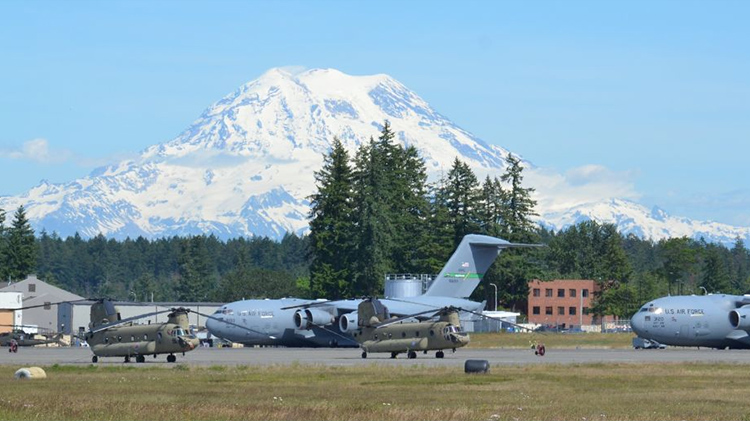
A Joint Base Lewis-McChord C-17 will demonstrate the capabilities of the United States Air Force’s newest cargo aircraft flying a tactical demonstration. Flown by an active-duty aircrew from the 62nd Airlift Wing, the C-17 is capable of rapid strategic delivery of troops and all types of cargo to main operating bases or directly to forward bases in the deployment area. The aircraft is also capable of performing tactical airlift and airdrop missions when required. Watch for yourself as aircrews fly this massive airframe with the agility of a fighter aircraft, albeit, large fighter aircraft, in amazing tight turns and through maneuvers they actually fly in combat
C-17 “Globemaster III” Fact Sheet
Engines………….........Four Pratt and Whitney F117-PW-100 turbofan engines
Thrust…………………40,440 pounds, each engine
Wingspan…………….169 feet
Length………………..174 feet
Height………………...55 feet
Speed………………...517 mph at 28,000 feet (Mach .76)
Service Ceiling………45,000 feet at cruising speed
Range………………..Worldwide with in-flight refueling
Crew…………………Three (two pilots and one loadmaster) aeromedical evacuation crew: A basic crew of five (two flight nurses and three medical technicians) is added for aeromedical evacuation missions. Medical crew may be altered as required by the needs of patients
Max takeoff weight….585,000 pounds
Load………………….170,900 pounds; 102 fully-equipped paratroopers; 36 litter and 54 ambulatory patients and attendants
62nd Airlift Wing/446th Airlift Wing C-17 3-ship Air Drop
Joint Base Lewis-McChord’s aircrew members from the Air Force’s 62nd Airlift Wing (active duty) and the 446th Airlift Wing (Air Force Reserve) combine forces to demonstrate a 3-ship airdrop right in front of the fans of the Air Expo. The C-17 can carry 102 parachutists at any one time. Tactical operations include personnel static-line and military freefall airdrops, A7/A21 containers airdrop, Low Velocity Air Drop of heavy equipment, container delivery system, and Low Altitude Parachute Extraction System.
www.62aw.af.mil / www.446aw.afrc.af.mil
F/A-18F Super Hornet Tactical Demo
The Tactical Demonstration or "Tac Demo" team flies a two-seat F/A-18F Super Hornet as close to the "edge of the envelope" as safety and prudence allows. The routine highlights the F/A-18F Super Hornet’s maneuverability and slow-speed handling characteristics and has been very well received around the country.
VFA-122 is the Fleet Replacement Squadron (FRS) for the Navy's newest fighter, the F/A-18 E/F Super Hornet. Based at NAS Lemoore, Calif., the squadron trains aircrew and maintenance personnel to fly and fix the F/A-18E/F Super Hornet.
F/A-18E/F Super Hornet Fact Sheet
EnginesTwo F414-GE-400 turbofan engines. 22,000 pounds (9,977 kg) static thrust per engine.
Length………………...60.3 feet (18.5 meters)
Height………………...16 feet
Wingspan……………..44 feet
Weight………………...Maximum Take Off Gross Weight is 66,000 pounds
Airspeed………………Mach 1.8+.
Ceiling………………...50,000 feet
Range………………...Combat: 1,275 nautical miles
Armament……………One M61A1/A2 Vulcan 20mm cannon; AIM 9 Sidewinder, AIM-9X (projected), AIM 7 Sparrow,
AIM-120 AMRAAM, Harpoon, Harm, SLAM, SLAM-ER (projected), Maverick missiles; Joint Stand-Off Weapon (JSOW); Joint Direct Attack Munition (JDAM); Data Link Pod; Paveway Laser Guided Bomb; various general purpose bombs, mines and rockets.
U.S. Navy Legacy Flight
The U.S. Navy Legacy Flight program matches today’s frontline fighters with their predecessors in close flight maneuvers at airshows nationwide. The U.S. Navy’s F-18 Tactical Demonstration Flight will fly off the wingtips or World War II, Korean and Vietnam-era fighters. For the Joint Base Lewis-McChord Air Expo, the F-18 will fly with the FJ-4U Fury.
F/A-18E/F Super Hornet Fact Sheet
EnginesTwo F414-GE-400 turbofan engines. 22,000 pounds (9,977 kg) static thrust per engine.
Length………………...60.3 feet (18.5 meters)
Height………………...16 feet
Wingspan……………..44 feet
Weight………………...Maximum Take Off Gross Weight is 66,000 pounds\
Airspeed………………Mach 1.8+.
Ceiling………………...50,000 feet
Range………………...Combat: 1,275 nautical miles
Armament…………….One M61A1/A2 Vulcan 20mm cannon; AIM 9 Sidewinder, AIM-9X (projected), AIM 7 Sparrow, AIM-120 AMRAAM, Harpoon, Harm, SLAM, SLAM-ER (projected), Maverick missiles; Joint Stand-Off Weapon (JSOW); Joint Direct Attack Munition (JDAM); Data Link Pod; Paveway Laser Guided Bomb; various general purpose bombs, mines and rockets.
United States Heritage Flight
The U.S. Air Force Heritage Flight program presents the evolution of Air Force air power by flying today's state-of-the-art fighter aircraft in close formation with vintage fighter aircraft.
A Heritage Flight performance involves a current Air Force fighter, piloted by an Air Combat Command single-ship demonstration team pilolt and flown with a historical Warbird, piloted by a trained and certified civilian Heritage Flight pilot.
The program includes eight active-duty pilots (six demo team pilots and two QF-4 pilots) along with nine civilians.
The Heritage Flight formations of modern fighters flying with World War II, Korean, and Vietnam era fighters such as the P-51 Mustang and F-86 Sabre, dramatically display our U.S. Air Force air power history and proudly support our Air Force's recruiting and retention efforts.
F4 Phantom II
The F-4 Phantom II is a twin engine, all weather, tactical fighter-bomber. It originally performed three tactical air roles: air superiority, interdiction and close-air support. The F-4 continues to serve in retirement as the QF-4 Aerial Target, an unmanned, high performance aerial target used for live air-to-air and surface-to-air missile tests.
In its air-to-ground role, the F-4 Phantom II could carry twice the normal load of a World War II-era B-17 bomber. Weapons and/or external tanks can be carried on nine external store stations. A typical configuration for an F-4C in 1967 consisted of four AIM-7E and four AIM-9B air-to-air missiles, and eight 750-pound Mk 117 bombs. The aircraft also carried two external fuel tanks on the outboard pylons and one ALQ-87 electronic countermeasures (ECM) pod on the right inboard pylon.
AH-1 Cobra
The AH-1 Cobra is a two-bladed, single engine attack helicopter manufactured by Bell. It shares a common engine, transmission and rotor system with the older UH-1 Iroquois. The AH-1 is also referred to as the HueyCobra or Snake. The AH-1 was the backbone of the United States Army's attack helicopter fleet, but has been replaced by the AH-64 Apache in Army service. Upgraded versions continue to fly with the militaries of several other nations. The AH-1 twin engine versions remain in service with United States Marine Corps as the service's primary attack helicopter. Surplus AH-1 helicopters have been converted for fighting forest fires. The United States Forest Service refers to their program as the Firewatch Cobra. Garlick Helicopters also converts surplus AH-1s for forest firefighting under the name, FireSnake.